
Mark Hines: The Invisible Man Who Fixed Britain’s Most Famous Building (While His Wife Got All the Fame)
There’s a certain type of person who spends their life making things right and never once asks you to notice. Mark Hines is that person. Architect. Conservationist. The man who kept BBC Broadcasting House from becoming a glass-and-steel atrocity. And, yes, husband of Lucy Worsley — which is, depressingly, the reason most of you even typed his name into a search bar at three in the morning on a Tuesday.
That stings a little. Because Hines is the type of professional whose fingerprints can be found on buildings you’ve passed, worked in, or seen on television if you really look into what he’s done. without ever registering his name on the credits. That’s the deal he made. That’s the deal he seems to like.
Quick Bio
| Detail | Info |
| Full Name | Mark Andrew Hines |
| Born | June 1967 |
| Nationality | British |
| Profession | Architect, heritage conservationist, author |
| Key Firm | MacCormac Jamieson Prichard (MJP), then Mark Hines Architects (founded 2006, wound down 2024) |
| Major Project | BBC Broadcasting House redevelopment, London |
| Scholarship | SPAB Lethaby Scholar |
| Spouse | Lucy Worsley (married November 2011) |
| Children | None — by deliberate choice |
| Home | Southwark, south London |
| Social Media | None worth mentioning |
London Boy, Quiet Ambitions
He grew up in London. Absorbed the city the way some kids absorb football kits or pop music. Buildings talked to him. Not metaphorically. Literally — the kind of visceral pull toward old brick and stone and the stories compressed inside them that either grabs you young or never grabs you at all.
He studied architecture the proper, grinding British way. Got his credentials, got registered, got serious. Didn’t go on a reality show about it.
Then came the Lethaby Scholarship from the Society for the Protection of Ancient Buildings — the SPAB, which sounds faintly ridiculous until you realize it was founded by William Morris himself, the socialist-craftsman-genius who thought tearing down old things was a moral failure. Hines won it. That scholarship rewired him. You don’t come out of immersing yourself in Morris’s philosophy of repair over replacement without it permanently altering how you see every building you ever walk into again.
Also — and this is the detail that has spawned a thousand soppy “heritage romance” articles — SPAB is where he met Lucy Worsley. She was doing her early conservation training. He was already deep in philosophy. They shared an obsession. One thing led to another, as things tend to do when two people are equally weird about the same niche subject.
See also “Suzy Miller: The Woman They Traded for a Million Dollars and a Clean Divorce“
The MJP Years: Doing the Actual Work
MacCormac Jamieson Prichard was one of those firms that architecture nerds know and civilians don’t. Serious civic work. Institutional weight. Projects that required you to actually think rather than just render something shiny in software and wait for applause.
Hines climbed to Design Director. That’s not a title you wander into. It means people trust your eye for what a building should become and what it should stay.
He spent his most formative professional years here. Learning how to hold the tension between what an old building is and what a modern client desperately needs it to do. That tension is everything in conservation architecture. Get it wrong and you either mummify a building or gut it. Get it right and you make something that breathes across centuries.
He got it right. Repeatedly. Quietly.

Broadcasting House: The Job That Defined Everything
Let’s talk about this properly, because it deserves more than a bullet point.
Broadcasting House in Portland Place is an Art Deco masterpiece, Grade II* listed, completed in 1932, and it’s been the symbolic home of the BBC since before World War II. It has weight. History doesn’t just accumulate in places like that — it soaks into the fabric. The problem, by the time Hines got involved, was that the BBC had outgrown it in ways that would make you weep for any facilities manager who’d had to deal with it.
The brief was: modernize a media operation the size of a small city without murdering a listed Art Deco icon. That’s not a brief. That’s a philosophical paradox dressed up as a construction contract.
Hines, as Project Director at MJP, did it. It took years. Requires the kind of obsessive, painstaking care that doesn’t photograph well for press releases but is the difference between a building that works and one that becomes a cautionary tale. New infrastructure threaded through old bones. Modern broadcast requirements met. The Art Deco exterior — and the interior character — preserved.
He wrote a book on it. Literally. A definitive architectural text on Broadcasting House. The kind of thing that gets cited in academic papers and sits unread on expensive shelves, but matters in the way things that are factually correct and well-argued always matter, eventually, to someone.
Going Solo: Mark Hines Architects
- He founded his own practice. Took what he’d learned from two decades inside a major firm and decided to try it his own way.
Mark Hines Architects ran for nearly eighteen years — closing in 2024. That’s not a failure. That’s a full career arc inside a single practice, which in the brutal economics of UK architecture is actually remarkable. The firm did residential, heritage, conservation — the kind of projects that require patience and craft rather than the loudest render in the room.
He didn’t win fame. He won commissions from people who knew what they were getting.
The Richmond House Fight: When Quiet Men Get Loud
Here’s where Hines surprised me, actually. Because I’d been assembling a picture of a man who lets his buildings speak and says nothing himself, and then I found the SAVE Britain’s Heritage press release from 2019.
Richmond House in Whitehall. Parliament wanted to demolish all but a fragment of this perfectly good, well-maintained, Grade II listed building — designed by Sir William Whitfield, Post-Modern civic architecture from 1988 — to build a temporary House of Commons while the Palace of Westminster got its own massive renovation.
The heritage world went ballistic. And Hines was among the loudest voices.
He said — and this is as close to polemical as this man apparently gets — that a new building would pump enormous quantities of carbon into the atmosphere, potentially equivalent to over 15,000 flights from London to New York. He didn’t just oppose the demolition aesthetically. He put numbers on the absurdity of it. That’s an architect who has fully metabolized the climate argument and turned it into a blade.
He worked with SAVE Britain’s Heritage on this. Stood in front of professional bodies and said: you declared a climate emergency, Parliament. Now act like it.
That fight put him at the center of a genuinely national debate about how we treat listed modern buildings, what retrofit-first actually means in practice, and whether the people running the country can hold two thoughts simultaneously (preserve history, reduce carbon). Spoiler: they often can’t.
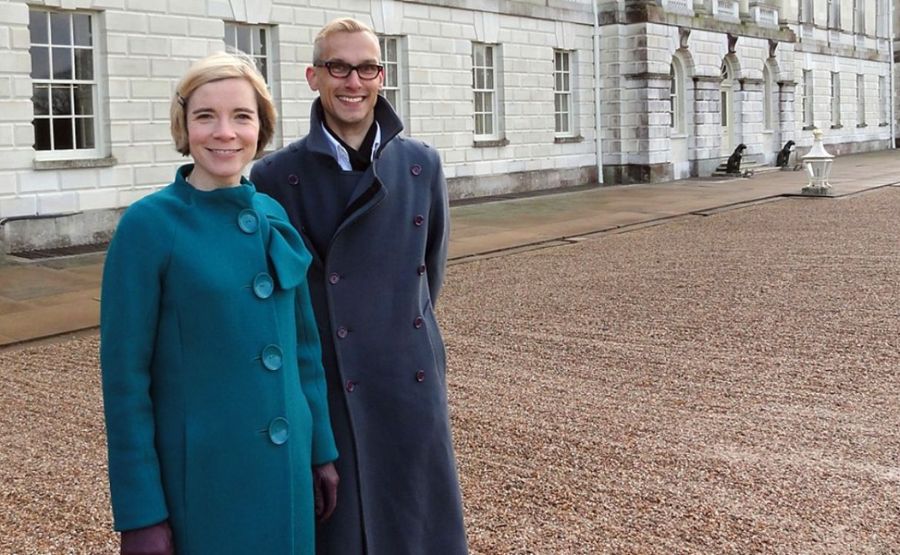
The Man Off the Clock
He and Lucy live in a loft in Southwark. Near the Thames. Described as minimalist, clean lines, bookshelves. Basically exactly what you’d expect two people who’ve spent their careers thinking about how space works to live in.
No children. Lucy has addressed this publicly and with characteristic directness — she told The Guardian that it was nobody’s business, that strangers had actually written letters to challenge her on it, and that what was right for others was simply not right for them. Mark doesn’t publicly discuss things, therefore he hasn’t said anything about it. It sounds like they made the decision together, thoughtfully, and on their own.
They’ve been together since the late 1990s. Married in November 2011, after roughly twelve or thirteen years of whatever you call it when two people who are deeply serious about old buildings and clearly mad about each other take their time. The wedding was private. No glossy spreads. No Hello! magazine exclusives.
The internet finds this suspicious. Surely stability must be masking something. Surely no scandal means a secret scandal. Nope. Some people just live quietly.
The Weird Fame Problem
Here’s the bit that no one says out loud but everyone knows: Mark Hines gets Googled almost entirely because of his wife.
Lucy Worsley is one of the most recognizable faces in British historical broadcasting. She’s done more BBC documentaries than most people have had hot dinners. She’s got the voice, the on-screen confidence, the slightly theatrical delivery that makes you actually want to know about Tudor court politics at nine on a Sunday evening. She’s an institution.
So when people stumble across her name and go looking for the husband, they find Hines. And then the internet — bless it — starts generating content that is, charitably, not always well-sourced. False biographies. Invented children. Mix-ups with other people named Mark Hines entirely (there’s at least one Southern California ceramics artist and what appears to be an exercise physiologist who keeps showing up in searches, to everyone’s confusion).
The real Mark Hines is, in fact, less dramatic than the fictional one the internet assembles out of misattributed facts. He’s also more accomplished. But accomplishment without performance doesn’t trend.
What He Actually Stands For
You want his philosophy in a sentence? Here it is: the most radical thing you can do to a building is take care of it.
Retrofit over demolition. Repair over replacement. An old structure’s embedded carbon is an asset rather than a burden. Tearing something down and starting fresh is almost never the sustainable choice, no matter what the glossy renders suggest. Hines has been saying this at professional conferences, in written pieces, in submissions to heritage bodies, for his entire career.
He’s associated with the Twentieth Century Society. With SAVE Britain’s Heritage. With SPAB. Three organisations that fight — sometimes loudly, sometimes in the arcane language of planning law — to stop good buildings from being needlessly destroyed by people who confuse “new” with “better.”
He published on these themes. His essay “Conservation in the Age of Sustainability” connects his practice to the broader climate argument in ways that feel inevitable in retrospect and were actually quite ahead of the curve when he was making them.
A Take Nobody Asked For
Mark Hines is the quiet conscience of British architecture and he’ll never be famous for it. That’s the trade he made.
There’s something almost Buddhist about this career path — the total subordination of ego to the work, to the building, to the principle. He could have leaned into being “Lucy Worsley’s husband” and parlayed it into speaking gigs and a renovated public profile. He did not. He appears to have zero interest.
I find this genuinely rare and slightly baffling. We live in a world where everyone is a personal brand and anonymity reads as suspicious. Hines is just… a guy who fixes important things carefully and lets other people take the credit.
The BBC Broadcasting House stands. Richmond House — after considerable fighting — survived largely intact. Old buildings across London bear the invisible marks of his decisions. He’ll probably never trend on social media.
That’s the biography. Make of it what you will.
Final Words
He’s been at this since the mid-1990s. That’s thirty-plus years of showing up, doing precise work in a field that most people couldn’t describe at a dinner party, and caring enormously about things that most people walk past without looking up. That’s not nothing. That might, in the long run, be everything.
FAQs
1. Who is Mark Hines and why does anyone know his name?
He’s a British conservation architect who directed the BBC Broadcasting House redevelopment — and he’s married to historian Lucy Worsley, which is honestly why 90% of people go looking for him.
2. Is Mark Hines actually famous in architecture circles?
More than you’d think. He’s a Lethaby Scholar, associated with SAVE Britain’s Heritage and the SPAB, has spoken at professional conferences, and published on conservation theory. He’s known among people who care about the built environment. That community is smaller than it should be.
3. Did Mark and Lucy meet through work?
Yes. Both encountered each other through the Society for the Protection of Ancient Buildings in the late 1990s. Conservation nerds falling for conservation nerds. There’s a wholesome joke in here about the only matching in interests being buildings.
4. Why don’t they have children?
Lucy has publicly called it a deliberate choice. She’s pushed back on people who consider it a tragedy or a puzzle. Mark hasn’t commented publicly. The answer is: they chose not to, and it’s their business.
5. Where do Mark Hines and Lucy Worsley live?
A minimalist loft in Southwark, south London, near the Thames. It sounds exactly like where two people with their careers and aesthetic would live.
6. What happened to Mark Hines Architects?
He founded it in 2006, ran it for nearly eighteen years, and wound it down in 2024. A long run by any standard in independent practice.
7. What was the Richmond House controversy?
Parliament wanted to demolish a perfectly good Grade II listed modern building to build a temporary House of Commons. Hines helped lead the opposition, arguing — with specifics — about the carbon cost of demolition and the hypocrisy of a Parliament that had declared a climate emergency sanctioning pointless destruction.
8. Does Mark Hines have any social media presence?
No meaningful public social media profile. He has clearly chosen privacy as a lifestyle, not just a preference.
9. What is the SPAB Lethaby Scholarship?
One of the most prestigious awards in British conservation architecture. Given by the Society for the Protection of Ancient Buildings, founded by William Morris. It involves hands-on study of historical structures and repair techniques. Winning one is a significant credential in this world.
10. Why do so many bad biographies of Mark Hines exist online?
Celebrity-adjacent search traffic plus minimal verifiable personal information equals content farms filling the gap with fabricated or misattributed detail. He’s been confused with at least two other people named Mark Hines online.
11. What does Mark Hines think about modern construction?
He’s a vocal advocate for retrofit-first thinking — the idea that adapting and repairing existing structures is almost always preferable to demolition and new build, both for heritage reasons and for the carbon embedded in existing materials.
12. Is he just “Lucy Worsley’s husband”?
He is Lucy Worsley’s husband. He is also a significant figure in British conservation architecture, a published commentator on sustainability and heritage, and a man whose professional decisions affected some of the most important buildings in the country. Both things are true. The second one just photographs less well.
Read beyond the ordinary with The Nexus Magazine.