Dolphia Parker: The Woman Who Refused to Be a Footnote
She outlived the fame. Outlived most of the people who called her husband a genius. Outlived the show, the era, and even the polite indifference of a world that never really bothered to look at her. Dolphia Lee Parker died on April 19, 2026, at 93, in a hospital near Santa Barbara, surrounded by family who called her “GD” — Grandma Dolph — and apparently obeyed when she spoke. “GD knows all and says all,” the grandkids reportedly insisted. Which is about the most punk rock thing you can say about a woman the internet spent fifty years ignoring.
Quick Bio
| Detail | Information |
| Born | July 29, 1932 — Shattuck, Oklahoma |
| Died | April 19, 2026 — Santa Barbara, California (age 93) |
| Parents | Verner Vilas Parker & Gladys Violet Akers |
| Siblings | Five — grew up in a big, noisy household |
| Education | Sul Ross State University, Alpine, Texas |
| Married | Dan Blocker, September 1952 |
| Children | Danna Lynn, Debra Lee (twins, 1953), David (1955), Dirk (ca. 1957) |
| Known For | Being Dan Blocker’s wife. Which is what everyone says, but also kind of misses the whole point. |
Oklahoma Dirt and Texas Ranch Dust
Here’s what all the filler websites get wrong about Dolphia Parker. They say she was born in Texas. She wasn’t. She was born in Shattuck, Oklahoma — just over the border — and that small correction matters because it tells you something about who raised her. The Parkers were the kind of family that moved toward opportunity, not away from difficulty. When the older kids hit high school age, Gladys Parker packed up her children and spent the school year in Alpine, Texas, so they could get a real education. The father presumably stayed behind. There are entire PhD dissertations about what it means when a mother decides that.
Dolphia grew up ranch-hard. Not romantically hard. Practically hard. Quarter horses, early mornings, six kids in close quarters, the kind of life where you figure out pretty fast who you are because nobody has time to hold your hand while you figure it out.
She liked theater. She liked the outdoors. She was, by all surviving accounts, sharp and funny and not remotely interested in anyone’s approval.
That last part is the thread that runs through everything.
The Play, The Interruption, The Guy Who Wouldn’t Shut Up
Sul Ross State University, Alpine, Texas. Tiny school. Big sky country. Dolphia is working stage crew on a production of Arsenic and Old Lace. And there’s this massive, 6-foot-4 loudmouth in the audience who keeps making fun of the cast during the performance.
She walked over and told him to leave.
He did. But apparently he remembered her, because Dan Blocker — Korean War veteran, English teacher in progress, future television icon — kept showing up. They were both theater people. They kept running into each other in the way you do at a small college that basically has one building where interesting things happen.
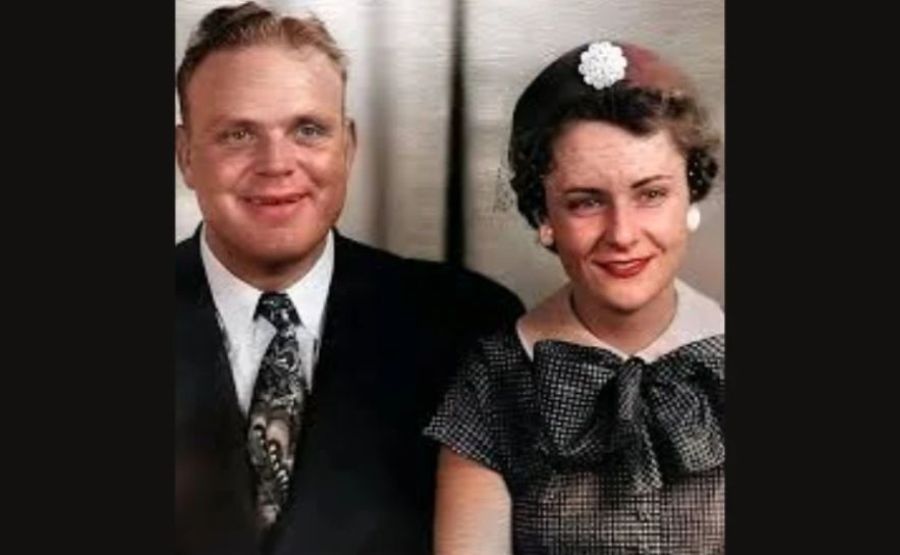
He was studying education. She was studying arts. He had a Purple Heart from Korea and she had the kind of directness that would later make her invisible to Hollywood — because Hollywood doesn’t actually want women who look you in the eye and say the thing.
They married in September 1952, right after he came back from the war. She was 19 or 20. He was 23. The twins arrived a year later. David the year after that.
Hollywood Wasn’t the Plan, It Was Dan’s Plan. She Came Anyway.
This is the bit that always gets to me. Dan Blocker was a schoolteacher in New Mexico — not a failing actor, not a hopeful kid. A working teacher with a Master’s degree, a wife, three small children, and a life that most people would have called perfectly fine.
He wanted to act. So they moved to California in late 1956 or ’57, kids in tow, no guarantee of anything.
That’s a lot of trust to put in someone. Or a lot of love. Or both — they’re not always the same thing and it’s worth not conflating them.
Dolphia got to Los Angeles, had their fourth child Dirk shortly after arriving, and then watched her husband spend two years scrambling for bit parts in Westerns. Guest spots on Gunsmoke. A recurring role on Cimarron City. One of his first gigs was a Three Stooges short. That’s the reality they lived in, the one she held together.
Then 1959 happened. Bonanza happened. And everything changed. Except Dolphia.
The Shadow Years (The Good Kind of Shadow)
Here’s a paragraph that you won’t see anywhere else, because most places don’t want to say it plainly: Dolphia Parker was deliberately, intentionally, almost aggressively absent from her husband’s public life. Not because she was pushed out. Because she decided.
While Dan became one of the most recognized faces in America — the No. 1 show for three straight seasons, 400-plus episodes of Hoss Cartwright, the gentle giant that a nation decided was basically the ideal American man — Dolphia was in Northridge with four kids, or later in Switzerland with four kids, or wherever the family had landed that week, doing the actual work of raising human beings.
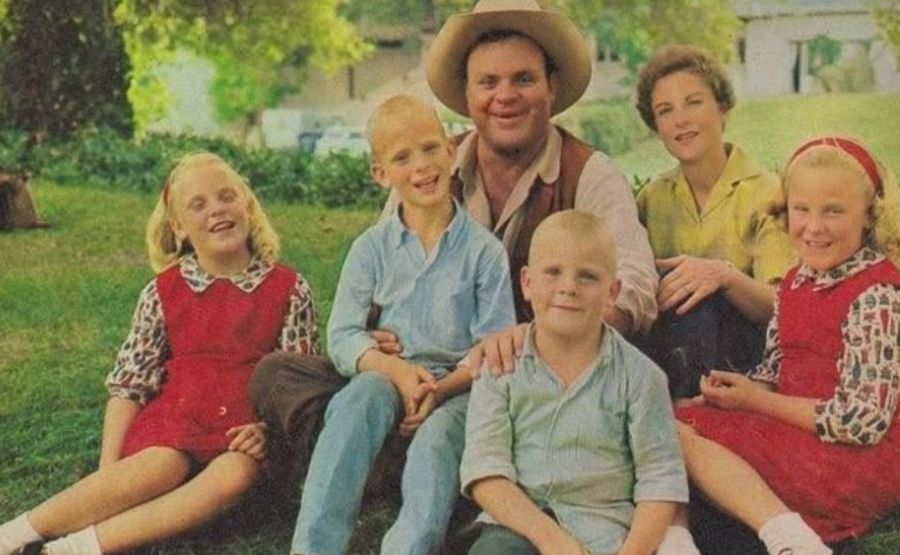
She almost never gave interviews. She didn’t attend Hollywood events. The TV Guide photo from 1964 — Dolphia, Dan, and all four kids at their Northridge home — might be the most visible she ever voluntarily got.
The thing about that decision that makes me want to disagree with her in the future is that she was correct. She was completely, demonstrably right. When Dan died suddenly in 1972, the women who’d been visible in Hollywood marriages were chewed up by the machine immediately. The widows who’d sold their proximity to fame had nothing left when the fame was gone. Dolphia had something real.
Switzerland, and Why
In 1970, Dan Blocker moved his family to Switzerland. The official story was that the kids were getting a great education, learning languages, experiencing Europe.He described Lugano as “the prettiest place I ever saw.”
That’s the nice version.
The version with more edge: Blocker was a liberal Democrat who had openly denounced American taxpayer money being used to “drop napalm on people in Southeast Asia.” He was anti-Vietnam War in a way that wasn’t subtle. A cowboy icon on a family Western who voted for Hubert Humphrey, hated Nixon, and eventually picked up his family and moved to another country to make a point.
Dolphia went. Think about what that means. You’ve finally got stability — your husband is a television star, you have a beautiful home, your kids are growing up — and he says, essentially, I need to leave this country to feel right about myself. And she went.
She spent months there with the children while Dan commuted back to Los Angeles to film Bonanza. He kept the Inglewood house. He flew back and forth. Rob Zombie now owns the Tudor mansion in Hancock Park, which is the kind of sentence that proves history has a sense of humor.
May 13, 1972. The Worst Possible Tuesday.
Dan Blocker went in for gallbladder surgery. In 1972 this was not considered dramatic. It was routine. People got their gallbladders out all the time. You went in, you came out, you went home.
He didn’t come out.
A pulmonary embolism — a blood clot in the lung — hit post-surgery. Sudden. Unpredictable. Fatal. He was still one of the most adored characters on American television at the age of 43, in the zenith of his career.
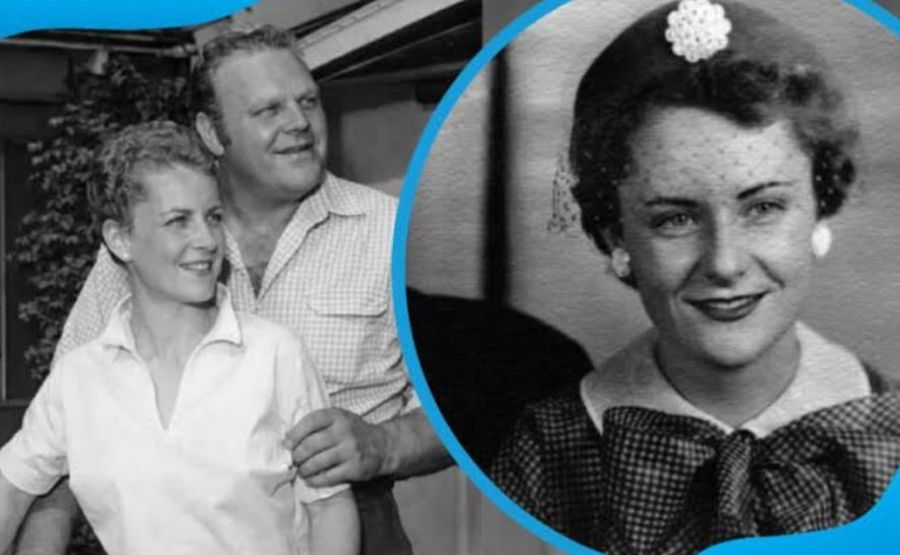
Dolphia was roughly 40. Four kids, the youngest still a teenager. Widowed by a blood clot that nobody saw coming, from a surgery that was supposed to fix something minor.
The show — which had been in the top 8 that season, still pulling massive numbers even after 13 years — barely survived one more season without him. The writers killed Hoss off in an “unspecified accident” and pretended that solved something. It didn’t. Bonanza was dead the moment Dan Blocker was.
Dolphia didn’t give interviews about any of this.
She didn’t write a memoir. She didn’t appear on talk shows to discuss her grief. The industry that had benefited enormously from her husband’s labor — and from the stable, invisible family life she had made possible — got nothing from her. Not a word.
I find that incredible. Honestly. We live in an age where grief is content, where loss is a personal brand pivot, and this woman in 1972 looked at every offer to be visible and said no.
After
She managed the estate. She raised the kids. David became a television producer. Dirk became an actor — you’ve seen him, he’s good, he was in Brooklyn Nine-Nine for years. The twins lived quieter lives. They all begin with the letter D. Dolphia insisted on that detail, apparently, which is either charming or slightly unhinged depending on your mood.
She eventually settled in Santa Barbara. Never remarried. The grandchildren called her GD and consulted her on important matters. Eight great-grandchildren.
She did all of this without ever once capitalizing on the thing most people were willing to pay for: her grief, her access, her proximity to a man America loved.
The Chuck Norris Detail
I keep coming back to this and I don’t know why. The Hollywood Reporter’s obituary mentions — almost in passing — that all four Blocker children took karate lessons from Chuck Norris.
Chuck Norris was a karate teacher in Los Angeles in the early ’60s before he became a movie star. The Blockers were apparently his students. Dolphia presumably drove four kids to karate class while her husband filmed Westerns.
I think about her in that parking lot, waiting. And I think — that’s the whole biography right there, isn’t it? The person in the parking lot who makes the visible life possible, and who history mostly forgets.
Except history forgot her wrong. She wasn’t passive. She wasn’t erased. She chose this.
What The Obituary Actually Said
The official obituary, published in the Los Angeles Times, described her as someone who “loved her family unconditionally” and was “a remarkable example of tolerance and acceptance, patience and love for others.” The grandkids’ line — “GD knows all and says all” — is in there, and it lands like a small firework in an otherwise careful document.
She was predeceased by three siblings. Survived by two sisters. And a family that by all accounts genuinely loved her. Not performance-loved her. Not tolerate her. Loved her.
She died the way she lived. Surrounded by the people she actually chose. Peacefully. In her 94th year. Having never once apologized for the privacy she kept.
Final Words
Dolphia Parker was born in a small Oklahoma town, moved to Texas ranch country, found theater, fell in love with a loud man she told to leave a building, followed him to Hollywood, helped him become one of the most beloved actors in American history, lost him at 43, raised four children into decent adults, moved to Santa Barbara, and died at 93 having given us basically nothing for the record.
And yet here we are.
The people who refuse to perform their lives are always the most interesting ones in retrospect. Dolphia figured that out early and kept figuring it out for nine decades.
GD knows all. And she never said more than she had to.
FAQs
1. Where was Dolphia Parker actually born?
Shattuck, Oklahoma — not Texas, despite what most websites say. The family later relocated to Alpine, Texas for the school years, which is where the confusion starts.
2. How did Dolphia and Dan Blocker meet?
At Sul Ross State University during a theater production of Arsenic and Old Lace. She was on stage crew. He was in the audience being disruptive. She told him to leave. He came back. They eventually married.
3. When did Dolphia Parker die?
April 19, 2026, from a stroke, at a hospital near her home in Santa Barbara. She was 93.
4. Did Dolphia Parker ever pursue acting?
She was active in college theater. She chose family over any professional stage career — a choice, not a limitation.
5. Why did the Blockers move to Switzerland?
Officially: for Lugano’s natural beauty and children’s education. Unofficially: Dan Blocker was vocally anti-Vietnam War and wanted to physically remove his family from a country whose policies he opposed. Dolphia went along with this, which says everything.
6. How many children did Dolphia and Dan Blocker have?
Four: twin daughters Danna Lynn and Debra Lee (born 1953), son David (born 1955), and son Dirk (born in Hollywood shortly after the family moved there around 1957). All four names start with D.
7. Did she ever remarry after Dan’s death?
No. She was widowed at roughly 40 in 1972 and remained single for the next 54 years. By choice, apparently.
8. What happened to Bonanza after Dan Blocker died?
It limped through one final season of 15 episodes, had the writers kill off Hoss in an “unspecified accident,” and then quietly ended. The show had been in the top 20 with Hoss still alive. Without him it was finished.
9. What did Dolphia Parker’s kids do with their lives?
David became a television producer. Dirk became an actor, probably most recognizable from Brooklyn Nine-Nine. The twins kept private lives. Notably, all four of the Blocker children took karate lessons from Chuck Norris.
10. How is it that so little is known about her?
Because she didn’t want you to know. That’s the whole answer. She wasn’t obscure because she was unimportant. She was obscure because she was extremely good at maintaining exactly the life she intended.
11. Was she close to Dan Blocker’s Bonanza co-stars?
There’s nothing substantial on record about her relationships with Lorne Greene, Michael Landon, or Pernell Roberts. She was absent from the public-facing world of the show almost entirely by design.
12. What was Dolphia Parker’s actual legacy?
Four children she raised with “consistency and purpose,” per one source that got the phrasing exactly right. Eight great-grandchildren. A 54-year refusal to trade grief for attention. And the fact that the grandkids’ best description of her — GD knows all and says all — is somehow the most interesting epitaph in this whole story.
Read beyond the ordinary with The Nexus Magazine.